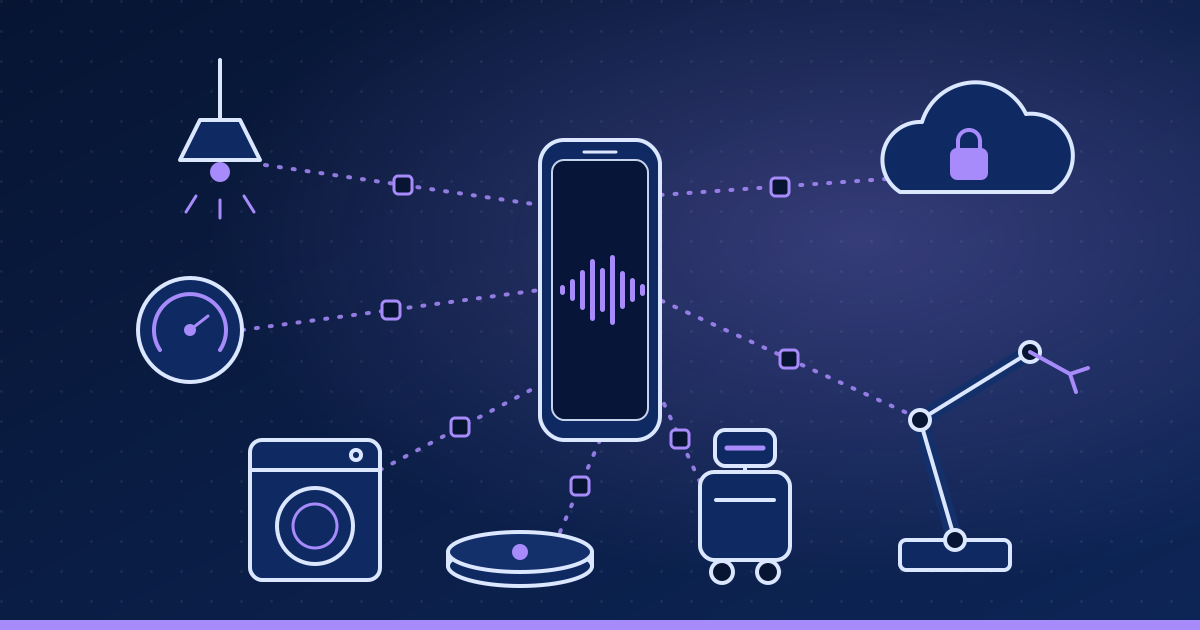
Most of us started small. We asked Alexa to turn on the kitchen lights, asked Siri to set a timer, and felt a little silly talking to a speaker. A few years later, plenty of homes have a thermostat, a lock, a robot vacuum and a washing machine that each answer to a different app.
On November 3, Apple opened its Siri AI Developer Preview to all developers. The assistant getting smarter is the headline. What interests me more is what happens when an assistant can reach more of the things around us, and who builds the bridges that let it.
We started by asking Alexa to turn on the lights
A voice command today is usually one device and one action. "Turn on the porch light." "Set the thermostat to 70." Useful, but each request is its own little island.
The jump I'm watching for is from commands to outcomes. You stop telling the assistant which switch to flip and start telling it what you're trying to get done.
Imagine a chief of staff for everything connected
A good chief of staff doesn't do every job personally. They know who to ask, what they're allowed to approve, and when to come back and say, "This part's done, this part needs you."
Now imagine that for everything with a chip in your life. You say, "Get the house ready for me to come home." A well-connected system might set the thermostat, turn on the entry lights, have the robot vacuum finish the living room before you walk in, and tell you the laundry finished an hour ago.
Or you say, "Prepare everything for tomorrow morning." It might check your calendar for an early meeting, set the coffee maker's supported schedule, adjust the heat, and report back: "Coffee is set for 6:15. The vacuum is stuck under the couch."
Those are possibilities, not a description of what Apple's preview does today. An assistant can only do what an app or integration has made available, with the person's permission, on a device that actually supports the action. A chip in a washing machine doesn't make it controllable by Siri. Somebody has to build the connection.
From smart homes to smart machines
The smart light is the easy example. Here's how the same idea could stretch, assuming the manufacturer offers the access and the safeguards:
- Laundry. "Is the wash done?" and "Let me know when it finishes" are status questions most connected washers could answer. Starting a cycle remotely is different: only if the maker supports it, and only with checks like a closed door.
- Robot vacuums. "Clean the kitchen" works if the vacuum's app exposes room cleaning. "The bin is full" is a status report it could send back.
- Climate. Thermostats are a natural fit: read the temperature, set a schedule, change a mode.
- Refrigerators. Inventory questions only make sense if the fridge actually tracks what's inside. Many don't.
- Cars. Checking the charge or warming the cabin depends entirely on what the carmaker's app allows.
- Delivery and service robots. A business could ask, "Where are today's deliveries?" and get a status summary. Telling a robot to go somewhere new is a bigger, safety-sensitive step.
- Industrial equipment. "Which machines on line 2 need maintenance this week?" is read-only monitoring, and it's valuable. Starting a press or moving a robot arm belongs behind safety systems, lockouts and people on site, not a casual sentence.
- Offices and buildings. Room temperature, lighting and occupancy in a building-management system could answer, "Is the conference room ready?"
Reading status and taking physical action are two very different jobs. Most of the early value, and most of the trust, will come from the first.
The next Zapier could connect the physical world
Zapier became valuable by connecting software products that were never designed to talk to each other. When a form was submitted in one tool, a record appeared in another.
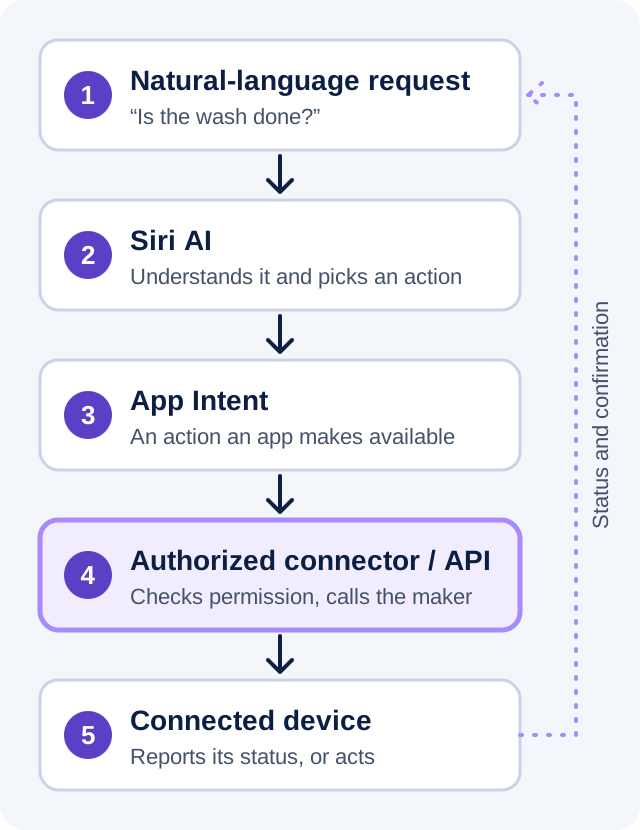
I think there's a comparable opportunity between what a person says and what happens in the physical world. Picture a company that builds integrations for dozens of appliance and equipment makers. Each manufacturer already has an API or an app. The connector company turns those functions into clean, permissioned actions, such as "check washer status" or "start cleaning the kitchen," and offers them through its own app.
The pieces of that connector layer look familiar to anyone who has built integrations:
- Manufacturer APIs and secure device integrations
- App Intents that describe each action and the data it needs
- Authentication and authorization for every account and device
- A standard way to describe what each device can do
- Event-driven updates, like "the cycle finished"
- Cloud-to-device communication, device discovery and status reporting
- Multi-step workflows across supported systems
- Logging, monitoring and safety controls
One important caveat: this is Zapier as a business idea, not a description of Apple's architecture. A third-party developer can't take over Siri's orchestration or call other apps' actions directly. Siri decides which actions to use. A connector company would expose its own authorized services and device actions through supported mechanisms, and Siri can then use those.
What Apple's Siri AI announcement actually changes
Here's what Apple said on November 3, checked against its developer documentation:
- The Siri AI Developer Preview starts with the iOS 27.3, iPadOS 27.3, macOS 27.3 and visionOS 27.3 betas, on devices that support Apple Intelligence and in regions where it's available.
- Any app can bring its content and actions into Siri AI using App Intents. Apple's getting-started guide describes app intents as the gateway to an app's features.
- Siri gets more natural language, personal context and onscreen awareness, and can carry a request across apps.
- Apple introduced skills to help Siri combine several actions into one experience. Apple also notes that skills guide Siri; they don't force a fixed sequence.
- Siri can only use custom actions and content an app explicitly makes available.
- For now, the preview works in development builds and with internal TestFlight testers. Apple says App Store submissions open in the spring, with the features reaching customers in a few months.
Some of this isn't new. Siri can already control HomeKit and Matter accessories through Apple Home, and Shortcuts already lets people chain app actions. What's new is the depth: more apps exposing more of their own actions to a far more capable assistant. Devices didn't become Siri-compatible overnight. Developers got a better way to make their apps, and the devices behind them, reachable.
The opportunity for software developers
I wouldn't wait for every manufacturer to build its own AI experience. The gap is interoperability. The work that fills it looks like this:
- Connecting manufacturers and their devices to conversational interfaces.
- Building reusable API adapters.
- Packaging device functions into permissioned, discoverable actions.
- Creating workflows that span multiple supported systems.
- Offering secure integration infrastructure to device makers.
- Maintaining connectors as platforms, APIs and firmware change.
If I were starting today, I'd keep the first version narrow, the way I'd scope any MVP:
- Pick one useful device category, such as laundry or climate.
- Confirm the manufacturer's API or protocol is actually available to you.
- Build a secure prototype against real devices.
- Design the App Intents: what each action does, and what it needs.
- Test it with the Siri AI developer preview.
- Test permissions, confirmations, latency and what happens when something fails.
- Put it in front of real users and see what they actually ask for.
- Only then expand toward a reusable catalog of connectors.
The advantage won't come from a clever demo. It'll come from speed, reliability, security, the breadth of supported devices, and how easy the connectors are for other developers to use. That's the same reasoning behind when custom software makes sense: own the piece that solves a recurring, measurable problem.
Building connections people can trust
A digital chief of staff needs boundaries. Asking whether the wash is done is harmless. Unlocking a door, placing an order or moving a machine can create physical, financial or privacy risk. The connector has to treat them differently:
- Explicit authorization from the person, for each account and device
- Least-privilege API access, so a connector can only do what it needs
- Secure authentication and careful token storage
- An easy way to revoke access
- Collecting as little personal data as possible
- Confirmation before consequential actions (App Intents can ask the person to confirm before acting)
- Audit trails and clear error reports
- Honest behavior when a device is offline: "The washer isn't responding," not a guess
- Hard safety limits on physical operations
Because Apple describes skills as guidance rather than enforcement, I'd put the hard rules in the connector and the device itself, not in the instructions you give the assistant. A friendly voice interface on top of a careless integration is still a careless integration.
The companies that build the connectors could shape what comes next
The future of AI-driven device control may depend not only on how intelligent assistants become, but on how effectively software developers connect them to the systems around us. The assistants will keep improving. The question is how many real things they'll be able to reach, and how safely.
If you're a manufacturer or a product team thinking about making your devices reachable this way, most of the work is API design, integration architecture and careful testing. That's the kind of work behind PreciseMP's Software & Application Development and AI & Intelligent Automation services, and Product Strategy & UX/UI is where the "which actions should we expose first?" question gets answered.